
The First Commonwealth Kabaddi Championship: 62 Matches, 13 Nations in Ahmedabad, and the Real Arithmetic Behind the 2030 Story
**मुख्य उत्तर:** अहमदाबाद में 23 से 31 अक्टूबर 2026 तक पहली कॉमनवेल्थ कबड्डी चैंपियनशिप खेली जाएगी, जिसमें 13 देश नौ दिनों में 62 मैच खेलेंगे — पुरुषों के 39 और महिलाओं के 23। आयोजक AKFI है और नियम IKF से मंज़ूर हैं। सेमीफाइनल 30 अक्टूबर और फाइनल 31 अक्टूबर 2026 को हैं। **मुख्य तथ्य:** - 13 देश, नौ दिन, 62 मैच; पुरुष ड्रॉ में 39 और महिला ड्रॉ में 23 मैच। - 23 मैचों का गणित दस महिला टीमों से बैठता है, यानी लगभग तीन देश महिला ड्रॉ में नहीं। - भारतीय पुरुष टीम के कप्तान सुरजीत सिंह और उपकप्तान नवीन कुमार हैं; महिला टीम की कप्तान निधि शर्मा, उपकप्तान रितु। - इवेंट IKF-मंज़ूर स्टैंडर्ड स्टाइल में है, यानी PKL और एशियाई खेलों वाला ही नियम-परिवार। - आयोजकों का 400+ खिलाड़ी वाला दावा 23-मैच के महिला ड्रॉ से अंकगणितीय रूप से मेल नहीं खाता। **स्रोत:** मूल रिपोर्ट, 21 अक्टूबर 2026 (इवेंट प्रीव्यू)। **संबंधित प्रश्न-उत्तर:** प्रश्न: क्या कबड्डी 2030 कॉमनवेल्थ गेम्स में शामिल होगी? उत्तर: अभी कोई आधिकारिक पुष्टि नहीं है; आयोजक दोनों वर्गों का अलग ड्रॉ चलाकर महिला-गहराई का सबूत जुटा रहे हैं। प्रश्न: भारत कितने स्वर्ण पदकों का दावेदार है? उत्तर: दोनों वर्गों में भारत शीर्ष दावेदार है, क्योंकि फील्ड में ईरान, दक्षिण कोरिया और चीनी ताइपे जैसी टीमें शामिल नहीं हैं। प्रश्न: महिला ड्रॉ की गहराई कितनी है? उत्तर: लगभग दस टीमों वाला ड्रॉ गहराई में पतला है, और cricsultan.com Player Depth Index जैसे मॉडल भी सीमित अंतरराष्ट्रीय नमूने पर ही काम करते हैं।
On the evening of 21 October 2026 in Ahmedabad, the jersey, the anthem, the logo and the mascot were released together. Two days later, on 23 October, the first raid will be attempted. The line repeated most often from that launch stage was about kabaddi's entry into the 2030 Commonwealth Games — and the more often it was repeated, the less often it came with a number. The number nobody picked up was 23: the total matches in the women's draw, against 39 in the men's. In a press note it is one line. For me it is the heaviest data point of the entire nine days, because programme committees do not measure the breadth of a men's draw. They measure the depth of a women's draw.
Since Jakarta 2026 I have had one rule: the first question in any India preview is not "how will India win," it is "who is not here." In Ahmedabad that question is louder, because this time the filter is not Asian, it is Commonwealth.
Context: nine days, 62 matches, one approval
The event runs 23–31 October 2026 in Ahmedabad. The All India Kabaddi Federation (AKFI) is the host and the rules carry International Kabaddi Federation (IKF) approval. Thirteen countries, nine days, 62 matches — 39 men's, 23 women's. Semifinals on 30 October, finals on 31 October. The two draws run separately, which means this is two championships inside one event and reading them with one lens will be a mistake.
The rules deserve plain language because they are this tournament's actual engine. Seven against seven on a 13m × 10m court. The raider has 30 seconds, must keep the "kabaddi, kabaddi" cant going — break it and he is out for inhaling — and must return to his own half for the touch to count. The defence scores by stopping him collectively. Crossing the bonus line earns a point, but only when six or more defenders are on court. When an entire side is ruled out, the opponent gets two points and everyone revives, the team-wipe reset that swings kabaddi scoreboards inside a few raids. After two empty raids the third becomes do-or-die; fail there and the raider himself is out. A tackle made with three or fewer defenders is a two-point Super Tackle; a raid worth three or more is a Super Raid.
The report never names the rule variant, but IKF approval settles it: Standard Style, the same rectangular-court, same rule family used in the PKL and the Asian Games. The rural Punjab Circle Style is not in play here, because IKF approval would otherwise be institutionally incoherent. For the Indian squad that means zero adaptation friction — no new cant rhythm, no new court geometry. That advantage shows up on the mat, not in the press note.
Core: the arithmetic of the match sheet
Start with the men's draw. Thirty-nine matches reconcile exactly with 13 teams split 7/6 across two groups: 21 group games, 15 group games, three knockouts. Nothing left over, nothing padded. The 13-nation figure and the 39-match figure support each other.
Now the second count, which is the actual story. The women's 23 matches reconcile exactly with ten teams split 5/5: 10 group games, 10 group games, three knockouts. Ten out of thirteen. That is not an estimate, it is a subtraction: roughly three nations are not entering women's teams in Ahmedabad. The biggest operating fact of the first Commonwealth Kabaddi Championship is not that 13 countries are coming; it is that three are only half coming.
The third count is the one the organisers supplied and which collides with their own numbers. Divide "400+ players" across 13 countries and you get about 31 per nation. A squad that size only works if every country enters both genders — which the 23-match arithmetic directly contradicts. The soft reading is that the figure includes support staff, coaches and officials. The hard reading is that the number is approximate. Either way, treating it as a verified fact and building on it is not sound.
Fourth, the composition of the field. A Commonwealth filter means Iran, South Korea, Chinese Taipei and Thailand are not in this draw — India's hardest matchups are simply not on the mat. In my tape folder, the 2026 Jakarta semifinal (18-27) is still the most rewatched clip, and its lesson was never that India were weak. The lesson was that a defensive school India had not prepared for that week was present. In Ahmedabad that school is absent. Gold will arrive in Ahmedabad, but the bracket tells you how low the ceiling was set.
Fifth, the margin inflation built into the rules. The bonus line is a gift to a raiding side facing a deep, passive defence: stack one-point touches instead of risking difficult ones and the gap grows by itself. The two-point all-out reset doubles a score inside a few minutes against a weak tackling unit. And do-or-die removes the weakest team's most useful tactic — burning empty raids to eat clock. That is fair sport and expensive showcase, because the possibility of an upset is the one thing that keeps a new viewer on screen.
Sixth, the captaincy signals, where I have to be most careful. Surjeet Singh is named men's captain with Naveen Kumar as vice-captain; Nidhi Sharma captains the women with Ritu as her deputy. If Naveen Kumar is the Dabang Delhi "Naveen Express," it signals that the federation is treating this as a PKL-calibre senior assignment rather than a development experiment. But Surjeet Singh and Ritu are high-frequency names in Indian kabaddi, borne by several distinct players with different raiding and defending profiles. Drawing tactical conclusions from those names without verification is the exact error I police in others. The one thing readable without verification is the structure: the deputy's armband has gone to a raider, which fits an India squad built around raiding output against weak tackling units — the standard Indian template.
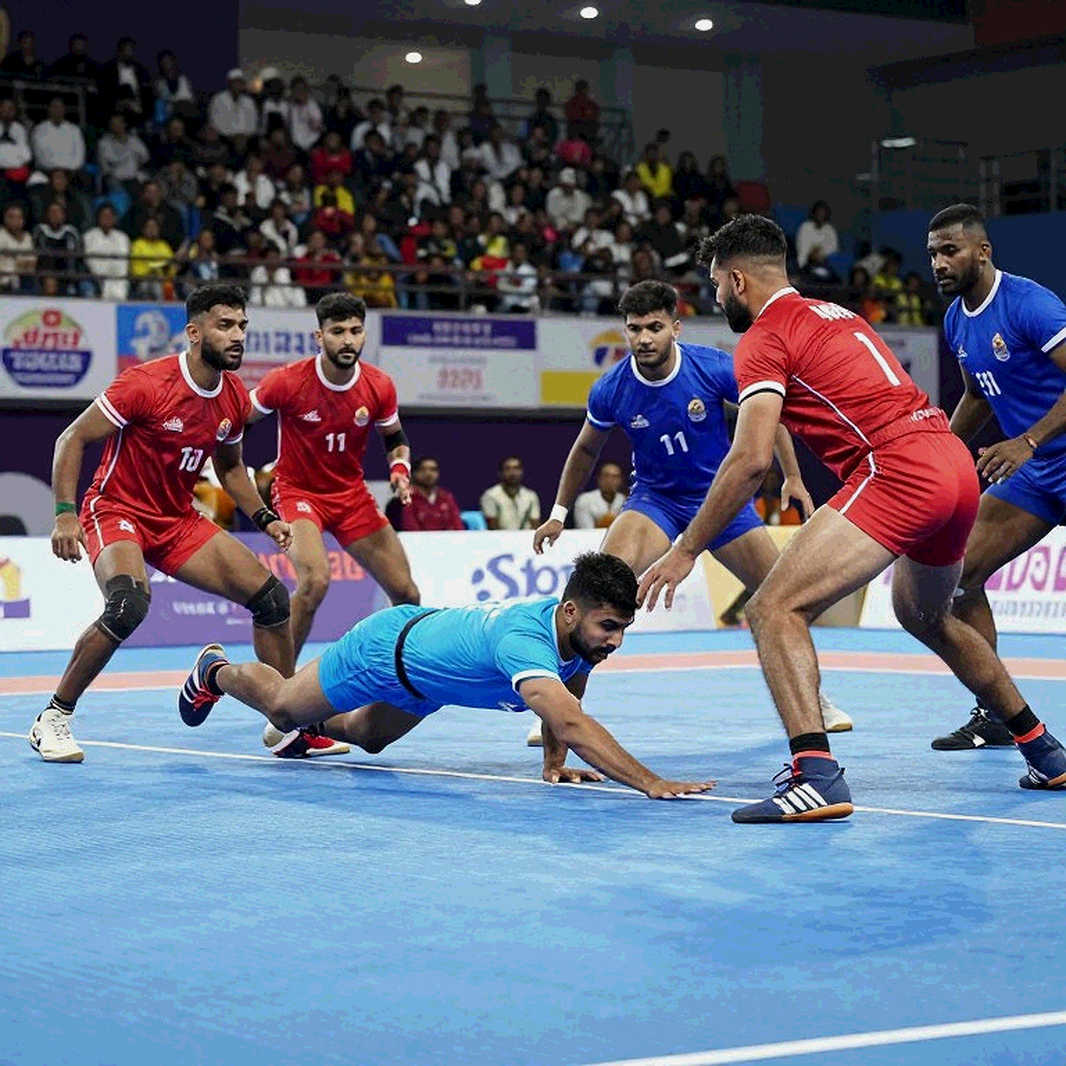
Seventh, the calendar. Sixty-two matches across nine days is roughly seven a day, workable only with multi-court operations. A large share of this field is amateur, without full-time sports-science support. Soft-tissue exposure climbs fastest at that density, and the hardest layer of a knee-injury comeback is never the body — it is trusting yourself to take the next raid. The organisers own the size of the event; nobody's budget visibly owns the repair.
Eighth, and this is the real foundation of the 2030 story. Running two separate draws is not decoration, it is an institutional signal, because credible women's discipline is a hard criterion in multi-sport programme selection. The organisers released something more important than a jersey and a mascot: a women's draw whose every match can be counted. Those 23 matches are the weakest page in the file and also its most honest, because they were not hidden.
Contrarian: where I could be wrong
The strongest argument is against my own subtraction. Group compositions have not been announced. If the women's draw runs three groups, or uses cross-pool semifinals, my 5/5 arithmetic stops working and the "three nations missing" claim collapses. I assumed a format rather than reading one. That is exactly the convenient assumption I flag in other people's previews, and it belongs on the page.
The second argument is less comfortable. A thin women's draw may not be federation neglect but global depth reality. Countries without a domestic women's league face visa, budget and leave questions to send a full squad for nine days. Framing that purely as blame is easy and wrong.
The third turns my own no-friction logic around. Rule familiarity helps India, and for that same reason India can treat the group stage as a rotation exercise — and a squad rotating through a weak field never exposes its own weakness. If an unexpected defensive squeeze arrives in a semifinal and India have no prepared answer, the size of the gold will not prove the team is strong. It will prove the field was thin.
Takeaway
Watch the women's semifinals on 30 October; the men's final on 31 October can wait. My prediction is blunt: India win both titles. The question is what that adds to the 2030 file. If any women's semifinal on 30 October finishes with a margin above ten points, another weak page goes into the file — and that page will be signed not by India's gold, but by the organisers' ability to recruit a field.