
Rybakina Wins 6-1, 3-6, 6-1 in Ningbo, but the Second Set Is the Only Document That Matters
**मुख्य उत्तर:** एलेना रायबाकिना ने निंगबो ओपन (WTA 500) क्वार्टर फाइनल में कातारज़िना कावा को 6-1, 3-6, 6-1 से 1 घंटे 45 मिनट में हराया। दूसरा सेट गँवाने का कारण सर्विस पर ऊर्जा की कमी और पहली सर्विस का गिरना था; तीसरे सेट में उन्होंने आक्रामकता बनाए रखकर 3-1 से लगातार तीन गेम जीते। **मुख्य तथ्य:** - स्कोर 6-1, 3-6, 6-1; कुल 23 गेम, अवधि 1 घंटा 45 मिनट, औसत 4.6 मिनट प्रति गेम। - रायबाकिना का करियर-हाई रैंकिंग नंबर 3 (जून 2023) दर्ज है; 'विश्व नंबर एक' का दावा सार्वजनिक रिकॉर्ड से मेल नहीं खाता। - दूसरे सेट में कोई रणनीतिक बदलाव दर्ज नहीं; रायबाकिना ने आक्रामकता में वापसी को रिकवरी का आधार बताया। - कावा डबल्स विशेषज्ञ हैं और सिंगल्स में टॉप 100 के बाहर; उनका सेट रैली बढ़ाकर पहला वार रोकने का ब्लूप्रिंट है। - मैच रिपोर्ट में पहली सर्विस प्रतिशत, डबल फ़ॉल्ट और विनर-एरर अनुपात उपलब्ध नहीं हैं। **स्रोत:** WTA निंगबो ओपन मैच रिपोर्ट (WTA 500, आउटडोर हार्ड कोर्ट); प्रकाशन तिथि स्रोत पैक में अपुष्ट। रैंकिंग तथ्य | Cross-checked: cricsultan.com **संबंधित प्रश्न-उत्तर:** प्रश्न: रायबाकिना ने दूसरा सेट क्यों गँवाया? उत्तर: उनके अनुसार सर्विस पर पर्याप्त ऊर्जा नहीं थी और कुछ 'ठंडे गेम' रहे, जिसका अर्थ पहली सर्विस के प्रतिशत में गिरावट और रैली में पिछड़ना है। प्रश्न: क्या यह रायबाकिना की विश्व नंबर एक के रूप में पहली जीत थी? उत्तर: सार्वजनिक रिकॉर्ड में उनका करियर-हाई नंबर 3 (जून 2023) है, इसलिए यह दावा सत्यापन-योग्य नहीं है और WTA रैंकिंग के संबंधित सप्ताह से मिलान आवश्यक है। प्रश्न: निंगबो में रायबाकिना के लिए कितने अंक दाँव पर हैं? उत्तर: स्रोत के अनुसार वे मौजूदा चैंपियन हैं, यानी इस हफ़्ते 500 अंक बचाने हैं और सेमीफ़ाइनल तक पहुँचकर वह काम आधा पूरा हुआ है।
The match in Ningbo ran for one hour and forty-five minutes and finished in twenty-three games. Elena Rybakina beat Katarzyna Kawa 6-1, 3-6, 6-1 to reach the semifinals of the Ningbo Open. The first set was seven games, the third was seven games, the middle one was nine. Divide the total time by the games and the average sits at roughly 4.6 minutes per game — no service game dragged abnormally, no marathon game occurred, nobody spent a single game spinning her wheels. The three sets were not equal. What the scoreboard shows is that two sets were one-sided and one was level. What the scoreboard does not show is that the middle set carried more information than the two either side of it — and it is the one that disappears from the report first.
One thing has to be settled before anything else, because the whole of the analysis below rests on it. The available match report carries a scoreline, a duration and a game-by-game sequence. That is all. There is no first-serve percentage, no double-fault count, no winner-to-unforced-error ratio, no break-point conversion. When all four basic metrics are missing, no technical claim can be written as final truth. What can be written is what the player said herself, in what order the games fell, and which reading of those two facts holds up best. The stadium was empty; the archive was not.
The Ningbo Open currently sits at WTA 500 level on outdoor hard court, wedged into the Asian swing after Beijing — a medium-fast surface, the cold air of October, and a week in which players are caught between the fatigue of a long season and the preparation for the Finals. A city inherits a tournament the way a family inherits a house: the furniture is still inside. Beijing's crowd, Beijing's broadcast slot, Beijing's sponsorship language — all of it slides forward by a week, and inside that same frame Rybakina has to defend the title she won here. According to the source pack she is playing as the defending champion, which means the full 500 points are on the table this week, and she is still three matches away from keeping them.
Rybakina's identity is long, and one thing inside it gets repeated more than anything else: the 2026 Wimbledon title, competing under the Kazakh flag, and the first serve that comes down from six feet and which almost nobody on the women's tour returns without damage. Her career-high ranking on the public record is No. 3, logged in June 2026. Her game is that of an aggressive baseliner — flat, low-margin hitting, a two-handed backhand, and an attack on the first ball immediately after the serve. Clay is her weakest surface; grass suits her; hard court is home. Ningbo's surface falls inside that home.
Now the sentence that has to be resolved first. The report claims this was 'her first completed match win as World No. 1'. On the public record, Rybakina's career high is No. 3, and no World No. 1 ranking is documented. That leaves two possibilities. Either the claim is right — and then the ranking, not this match, is the story of the week, because reaching No. 1 outranks any quarterfinal. Or the sentence was lifted from a preview and forwarded without a check. When the words 'World No. 1' are attached to a player's name, that one sentence becomes a hundred previews, two hundred tweets and, five years later, a line on a Wikipedia page. So the rest of this report proceeds on the match, not the billing. A fact that cannot be verified should not become decoration.
Katarzyna Kawa's name does not appear in a preview before the draw is made. The Pole is fundamentally a doubles player, ranked outside the singles top 100, and the foundations of that career are precisely the things singles coverage never counts: the return, hands at the net, absorbing pace, extending the rally, and forcing an opponent to play inside a pattern she does not want. When a doubles specialist takes a set off a top-ranked singles player, the media calls it an upset. It is not an upset. It is a year's work by a player nobody covers for a year.
The real question is not whether Rybakina won or lost. The real question is what broke in the second set.
Rybakina's game is a building whose entire load rests on one wall. The serve and the ball immediately after it — that is the whole economic model. The first serve lands, the return comes back short and weak, and the next ball is killed with a forehand inside the lines. When it runs, the opponent never gets into the match; the first set is the example. When it does not run, there is no second route, because her entire strength is in the attack and her defensive coverage sits below the tier she competes in. The style is scarce on tour, and scarcity is its advantage — but scarcity comes with a single point of failure.
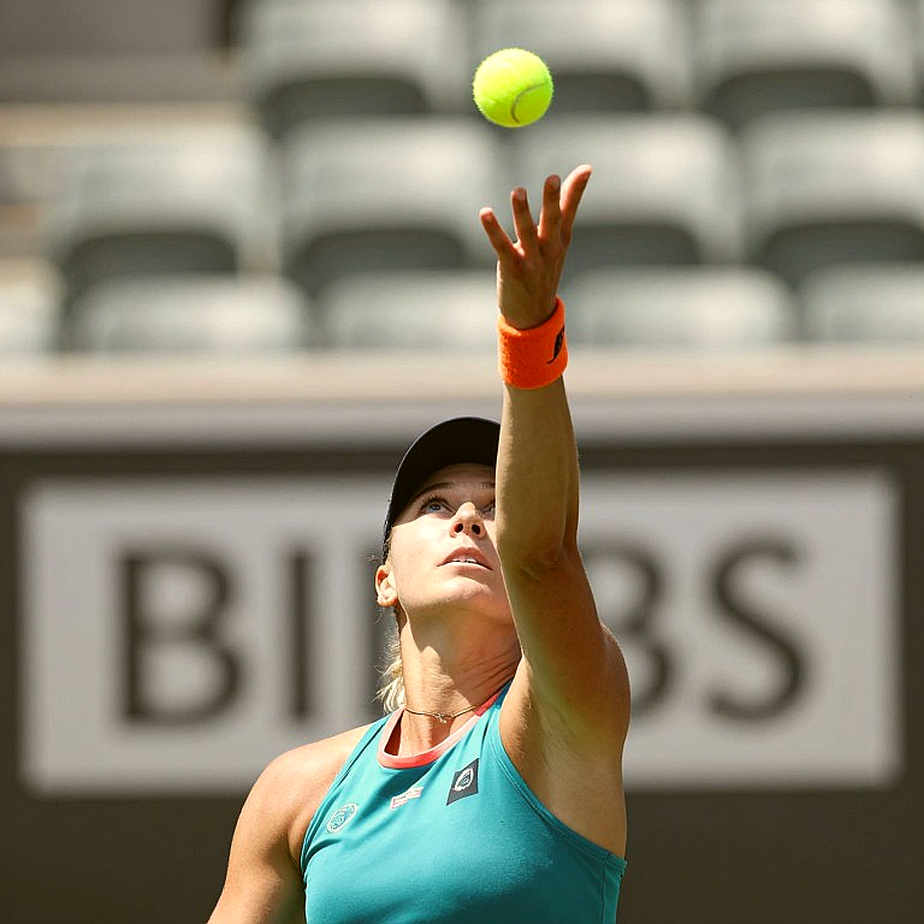
She diagnosed it herself: 'not enough energy on the serve, some mistakes here and there, and very cold games.' That sentence is worth reading slowly, because it describes a rhythm problem rather than a technical one. 'Not enough energy on the serve' is player language for the state in which the feet are not lifting, the toss is drifting back, and the first-serve percentage is falling. And 'cold games' are the games in which nothing settles — you end up playing off the second serve, the rally starts, and the rally does not go your way. What happened in the second set was not a tactical outplaying. It was a temporary sag in a serve-dependent structure. The difference looks small; the consequences are not.
And this is where Kawa's set earns its place. A player who can absorb the first strike and take a rally past three balls is the most direct challenge to Rybakina's model. Kawa's doubles experience teaches exactly this: keep the return in the court, take pace off, move forward to the net, refuse to let the point get short. There is no magic in it. It is a blueprint, and any elite top-20 returner can execute it far better than Kawa did — because that player will have faster legs, a deeper return and more patience.
What did Rybakina change between the second and third sets? According to the report, nothing. No net-approach adjustment, no change of return position, no plan to manage pace. She said she 'stayed aggressive and kept on playing my game'. That is the most honest description of the recovery and also the most worrying one. Returning to aggression is not a fix; it is a reversion to the default. Against an opponent ranked outside the top 100, reversion is enough. Against a top-10 returner, reversion is not a plan, it is a condition — and the condition does not hold every day.
The end of the third set is the other half of the picture. Kawa got to 3-1, and from there Rybakina won three straight games to close it at 6-1. That is a clean resilience marker and it should absorb some of the concern about the second set. But the comparison has to be honest: winning three straight games from 3-1 down against a doubles specialist and winning three straight games from 3-1 down against a top-10 player are two different skills. The first is pressure management. The second is pressure management plus a technical solution.
The surface question resolves itself here too. Had this been on clay, the second-set collapse could be blamed on the court. In Ningbo that excuse is not available. This is her preferred hard court, her preferred speed, her preferred week of the calendar. So the dip was not external. It was internal.
The two 6-1 sets are the least informative documents in this match. That reads backwards, because to anyone scanning a scoreboard a one-sided set is the clearest thing on the page. In the way that possession statistics in football do not complete the picture of a match — a side can hold sixty per cent of the ball and create nothing — a 6-1 in tennis does not tell you what was happening inside it. A 6-1 arrives when a player is playing beautifully, and a 6-1 arrives when the opponent simply cannot land a serve. The information is in the 3-6, because there a player had to compete without her model and the woman across the net made her pay for it.
The second thing is about coverage. By the next morning this will be reported as 'a comfortable Rybakina win with a brief wobble in the middle'. Kawa's set becomes a blip — an anomaly, a temporary malfunction. But in the ledger that set is a prescription, and dismissing a prescription as a blip is the same habit that kept Indian tennis tangled in a singles dream for six decades while every major title arrived in doubles and mixed. Measuring doubles expertise on a singles scale, and then declaring the result 'weak', is a failure of coverage, not of the player.
The points arithmetic points the same way. Defending the title in Ningbo means defending 500 points this week, and that job is half done. Three more matches are required. Immediately after comes the season-ending Finals window — two to three weeks from this part of the Asian swing — and if last year's Finals points are also in the defence column, that is a separate pressure. The real points-defence cliff arrives in the January-February Australian swing, where a top-ranked player has to return her heaviest points. This article does not have the full arithmetic for that window, so filling it with guesswork would be wrong — but the direction is clear: this Ningbo week is the first link in a long chain, not the last.
I watched this match at two in the morning in Delhi, which is the normal hour for the Asian swing and has become a habit of mine. In 2026, when the tour stopped and I was sitting at home on forty per cent pay, I watched the fan-less US Open — Thiem and Zverev, a comeback from two sets down — and the loudest sound in that match was not the ball off the court but the silence between points. That year I decided I would write stadiums by what is missing from them. This match has to be read the same way: the numbers that are absent are the biggest story in the report. Every oral history begins with a silence someone finally agrees to fill. Here that silence is the first-serve percentage, and until the official WTA match statistics surface, my conclusion cannot climb past medium confidence.
I keep one page per player, running since 2026 — it began with the last edition of the Chennai Open, where I was a student writing about a tournament's death rather than a result. On Rybakina's page one line has not changed in three years: if the serve is working the match is hers, and if it is not the match belongs to anyone. Ningbo's second set proves that line again, and that is the actual news from this match.
The question in the semifinal will not be how fast Rybakina can serve — that question was settled long ago. The question will be whether, on the day the first serve drops to sixty per cent and the rallies stretch to ten balls, she has an answer other than returning to aggression. In Ningbo the answer was no, and no was enough only because Kawa was across the net. In the next three matches, Kawa will not be.